> ## Documentation Index
> Fetch the complete documentation index at: https://inflexion.mintlify.site/llms.txt
> Use this file to discover all available pages before exploring further.
# Depositor risk disclosure
> What a cvAMM depositor actually earns and risks — the heavy-run figures, the structural levers, and the mandatory disclosure tone. Capital is not guaranteed.
A cvAMM depositor is a **volatility seller**: you collect a premium priced under the
risk-neutral measure at a conservative [`σ_ref`](/math/sigma-ref), and you pay
realized `min(IL, MaxIL)` under the *real* measure. In calm markets that gap is your
yield. In a crash you pay the whole synchronized book. There is no version of selling
volatility that is also a savings account.
This page states the downside in the same breath as the upside and lets the quant
figures speak in raw numbers.
**Depositor capital is NOT guaranteed: the junior tranche is first-loss; the senior tranche is structurally protected from underwriting loss only, not systemic tail.**
Underwriting capital — whether supplied to the pooled cvAMM vault (Path A) or posted directly by a market maker (Path B) — is **at risk**:
* **Junior tranche — first-loss.** Junior depositors absorb underwriting losses first and buffer the senior tranche.
* **Senior tranche — protected from underwriting loss, exposed to the systemic tail.** The senior tranche is structurally shielded from ordinary underwriting loss while junior capital buffers, but it still takes the systemic tail once the junior buffer is exhausted.
No-bad-debt is a guarantee to the **LP being paid** (see the FULL-mode payout clause), **not** a guarantee that depositor or MM capital is preserved.
## The one identity that governs everything
Every figure on this page falls out of a single monthly P\&L identity. It makes the
volatility-seller nature mechanical, not rhetorical:
$$
\text{monthly\_return} \;=\; \text{utilization}\cdot\frac{\sum_i\bigl(\text{premium}_i - \text{payout}_i\bigr)}{\sum_i \text{MaxIL}_i}
$$
$$
\text{premium}_i = \text{fairRate}(\sigma_{\text{ref}})\cdot(1+\text{baseLoad})\cdot\text{MaxIL}_i
\quad\text{(income — risk-neutral, at }\sigma_{\text{ref}}\text{)}
$$
$$
\text{payout}_i = \min(\text{IL}_i,\ \text{MaxIL}_i)
\quad\text{(claim — paid under the }\textbf{real}\text{ measure)}
$$
Premium comes in priced at the conservative [`σ_ref`](/math/sigma-ref); payout goes
out under whatever the market actually did. The edge is the spread between the two —
the volatility-risk premium — **earned in calm months and given back in crashes.**
When realized vol exceeds the implied vol you priced at, you lose. That is not a bug
to be tuned away; it is the definition of the business.
**Two separate claims, never merged.** The LP's [no-bad-debt guarantee](/concepts/no-bad-debt)
(Claim A) is *structural* — `collateral = MaxIL ≥ payout` by construction — and holds
**regardless of how the depositor P\&L moves**. The depositor's capital-at-risk (Claim B)
is the economic substance of being a vol seller. Neither claim implies the other. We
state them side by side at the [bottom of this page](#the-two-claims-stated-side-by-side).
## The model — deliberately harder than reality
The figures below come from the **heavy run**. We did not calibrate to a friendly
model. We built one *stronger than GBM* on purpose, so the downside is stress-tested
past the obvious questions:
Returns are Student-t with 4 degrees of freedom, not Gaussian — heavy tails so a
bad month is genuinely bad, not a normal-distribution artifact.
Vol switches between **calm 0.45 / normal 0.75 / stressed 1.30** with persistence
0.82 — the same calm/normal/stressed bands the on-chain
[`baseLoad`](/math/load-stack) keys off (0.20 / 0.30 / 0.50). Stress clusters, as
it does in reality.
This is a **single-pair** book. In a deep move, the cross-position correlation
rises toward 1 — every open position settles against the *same* ETH move, so the
diversification that helps in calm markets evaporates exactly when you need it.
This is the honest worst case for a mono-factor vol seller.
On top of the regime model, \~0.8 deep-crash events per year with mean **−45%** —
bracketing March 2020, Terra-LUNA, FTX, and the 2022 bear (CoinGecko's free tier
is 401-gated, so this is a *labelled historical-episode-anchored real-measure*
calibration, not a fit to a clean dataset).
Critically, the model uses a **lagging `σ_ref`** so that coverage written at a
stress *onset* is underpriced exactly as it would be on-chain (vol lags the jump).
Measured payout/premium at onset = **1.14** — that residual is the
volatility-risk-premium the [`baseLoad`](/math/load-stack) must carry, **not** a
no-bad-debt risk.
**Limit → Why → Mitigation: the model is real-measure and adversarial, not a marketing backtest.**
* **Limit:** these are *model-illustrative* figures from a Monte Carlo, not realized
protocol history (none exists yet — the protocol is the mechanism that will create
it).
* **Why:** there is no public realized-IL dataset to backtest against; building one is
precisely the [data moat](/concepts/data-moat). So we used a synthetic model
calibrated to labelled historical crash episodes.
* **Mitigation:** the model is **stronger than GBM** on every axis above, and a
6-agent adversarial self-audit independently re-ran the engine. Treat the **risk
panel** as the robust part and the APY figures as illustrative.
## The headline figures — bare pool, unhedged, untranched
These are the **single-asset bare pool** numbers: before tranching, before the
optional roadmap hedge, at base loads (calm/normal/stressed = 20/30/50%), gross of
demand / competition / fees. **Lead with the geometric 3y CAGR, never the arithmetic
mean** — and read the risk columns as the robust part of the result.
| Operating point | 3y CAGR (med / p10 / p90) | P(3y NAV \< 1) | P(losing month) | 1-in-100 month | worst month | P(3y DD > 50%) | no bad debt |
| - | - | - | - | - | - | - | - |
| **Disciplined `u = 0.40`** | **122% / 50% / 247%** | 0.3% | **26.5%** | **−20.1%** | **−26.8%** | **2.7%** | ✓ |
| Fully-deployed `u = 0.60` | 209% / 72% / 491% | 0.5% | 26.5% | −30.1% | −40.1% | 18.0% | ✓ |
Every number means something specific. Here is what each one is actually telling you:
The volatility-risk premium compounds strongly in the median, with a **wide**
distribution. The p10 column is the honest downside of the *median run*, not the
worst case — even a 10th-percentile three-year path still grows. We lead with the
**geometric** CAGR because the arithmetic mean of a fat-tailed, compounding series
flatters the result.
This is **intrinsic to volatility selling**: you lose whenever realized vol
exceeds the implied vol you priced at. It does not improve with utilization
(26.5% at both `u = 0.40` and `u = 0.60`) because it is a property of the *measure
split*, not of how much capital is deployed. It is not a flaw to be tuned away.
At `u = 0.40`, a 1-in-100 month is **−20.1%** and the worst observed across 50,000
runs is **−26.8%**. Both worsen materially at `u = 0.60` (−30.1% / −40.1%). This
is the number a conservative depositor should anchor on — and it is exactly what
the [senior tranche](#the-structural-levers-how-the-targets-are-actually-met)
exists to remove.
The probability of a peak-to-trough drawdown over 50% across three years is
**2.7% at `u = 0.40`** versus **18.0% at `u = 0.60`** — a near-7× swing from one
parameter. Utilization is the dominant *drawdown* lever (not a tail-feasibility
lever), which is why the [`util_skew`](/math/load-stack) prices new coverage up
*before* the pool over-commits.
Across **every** simulated path and over a ±99% (and a widened −6…+6 log-move)
grid, `min(IL, MaxIL)/MaxIL ≤ 1.0` with `max_payout_frac = 1.000000`, zero
exceptions. The LP guarantee holds **structurally
and oracle-independently** even while the depositor P\&L swings violently. This is
the cleanest demonstration that the two claims are separate: the depositor can
have a −27% month while the LP is paid in full, from pre-locked collateral.
**The honest headline finding: an unhedged, untranched single-pair ETH pool CANNOT meet the safety targets at any *marketable* load.**
* **Limit:** the binding safety targets — **1-in-100 monthly loss `≤ 10%`** and
**P(losing month) `≤ 15%`** — are unreachable for a bare single-asset pool at any
load satisfying `premium ≤ MaxIL`.
* **Why:** these constraints are **intrinsic to single-asset volatility selling** —
you lose whenever realized > implied, and a synchronized crash pays the whole
correlated book at once. No load setting fixes that; charging more than `MaxIL`
would mean charging more than the maximum possible payout, which the
[I10 cap](/security/invariants) forbids by construction.
* **Mitigation:** we **did not loosen the targets**. The honest answer is the
*structural levers* — tranching at launch, the pool hedge on the roadmap (next
section). The bar stayed; the structure changed.
## What the underwriting fund looks like under a severe correlated crash
The figures above are summary statistics; the shape behind them is a Monte Carlo
distribution. These solvency visualizations show the underwriting fund's per-run P\&L
and ruin behavior under a **severe correlated crash** — the regime where the
single-pair book's correlation has risen toward 1 and the whole book settles against
one move. They are illustrative of the *mechanism* (collateral absorbs the bulk of
loss; the fund taps only on rare tails), not a forecast.
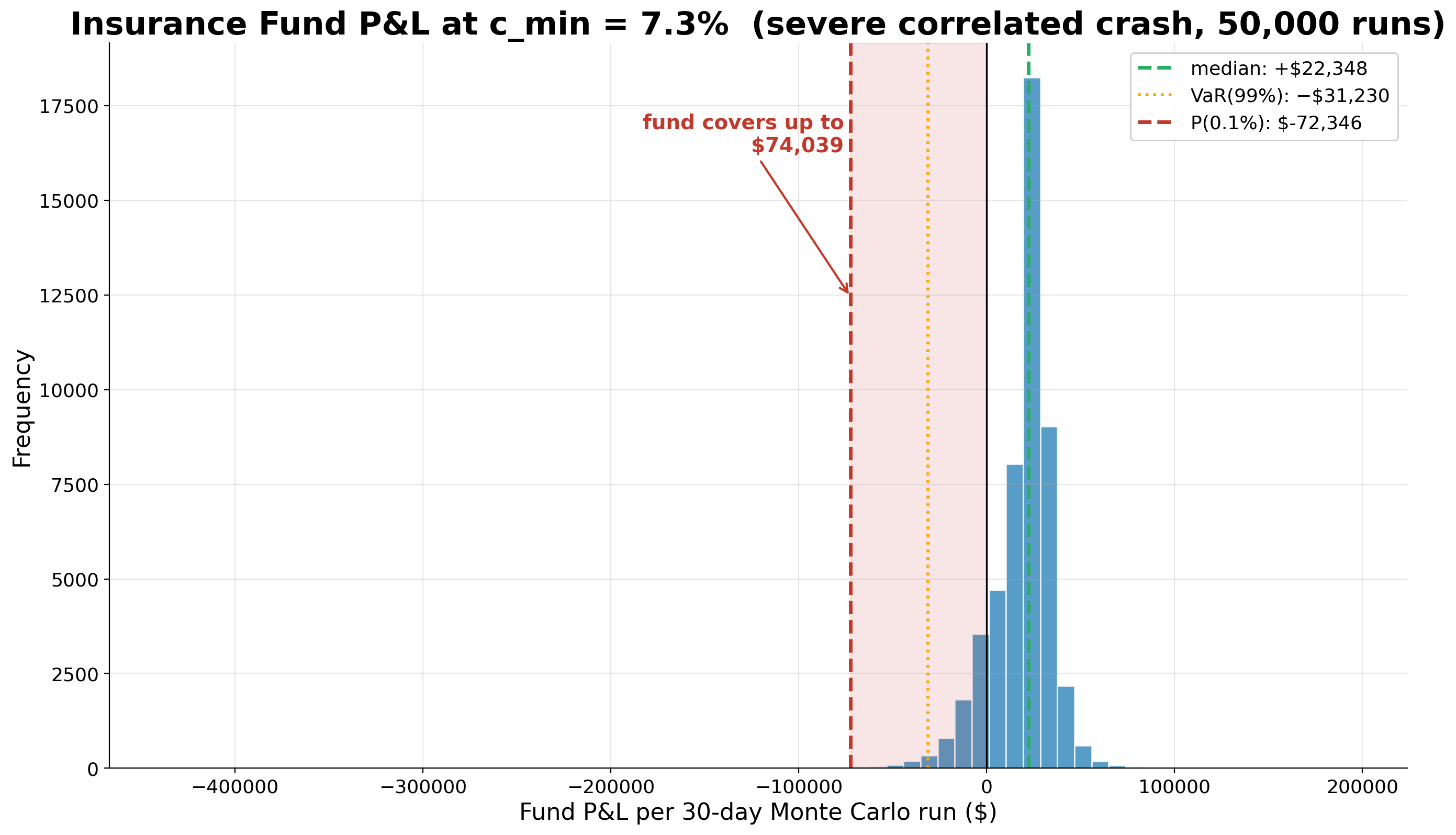 The distribution is the visual form of the headline table: a positive median (the
premium you earn in the \~73% of months that are not red) and a fat negative tail (the
crash months that drive the −26.8% worst month and the 26.5% loss-month rate). The
left edge is exactly the risk Claim B is about.
The distribution is the visual form of the headline table: a positive median (the
premium you earn in the \~73% of months that are not red) and a fat negative tail (the
crash months that drive the −26.8% worst month and the 26.5% loss-month rate). The
left edge is exactly the risk Claim B is about.
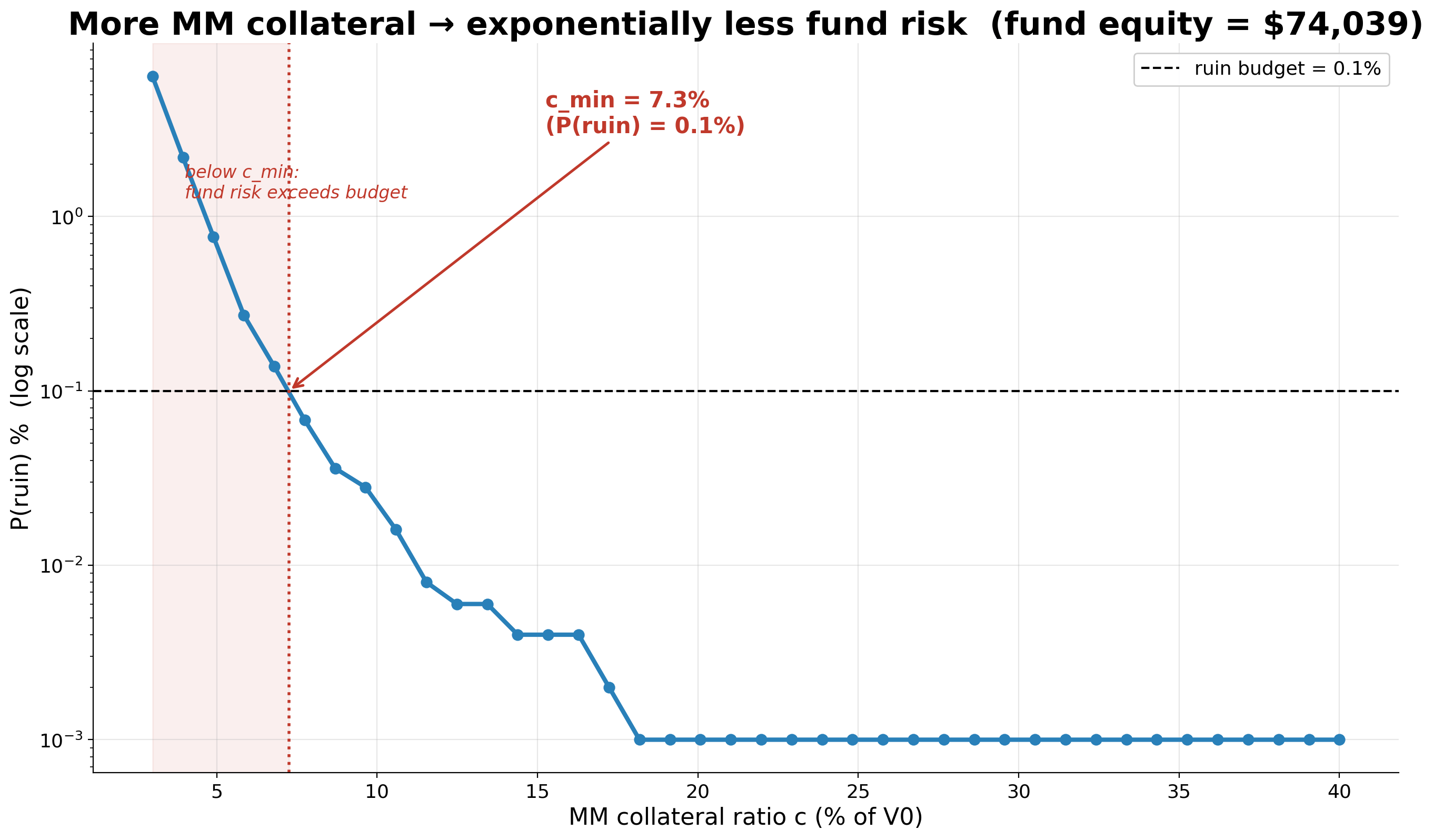 This is the collateralization story in one curve: ruin probability falls
**exponentially** in the underwriter's collateral ratio. In FULL mode the underwriter
posts exactly `MaxIL` — the right-hand, flat region of this curve — which is why
[no bad debt is structural](/concepts/no-bad-debt) for the LP regardless of where the
depositor P\&L lands.
This is the collateralization story in one curve: ruin probability falls
**exponentially** in the underwriter's collateral ratio. In FULL mode the underwriter
posts exactly `MaxIL` — the right-hand, flat region of this curve — which is why
[no bad debt is structural](/concepts/no-bad-debt) for the LP regardless of where the
depositor P\&L lands.
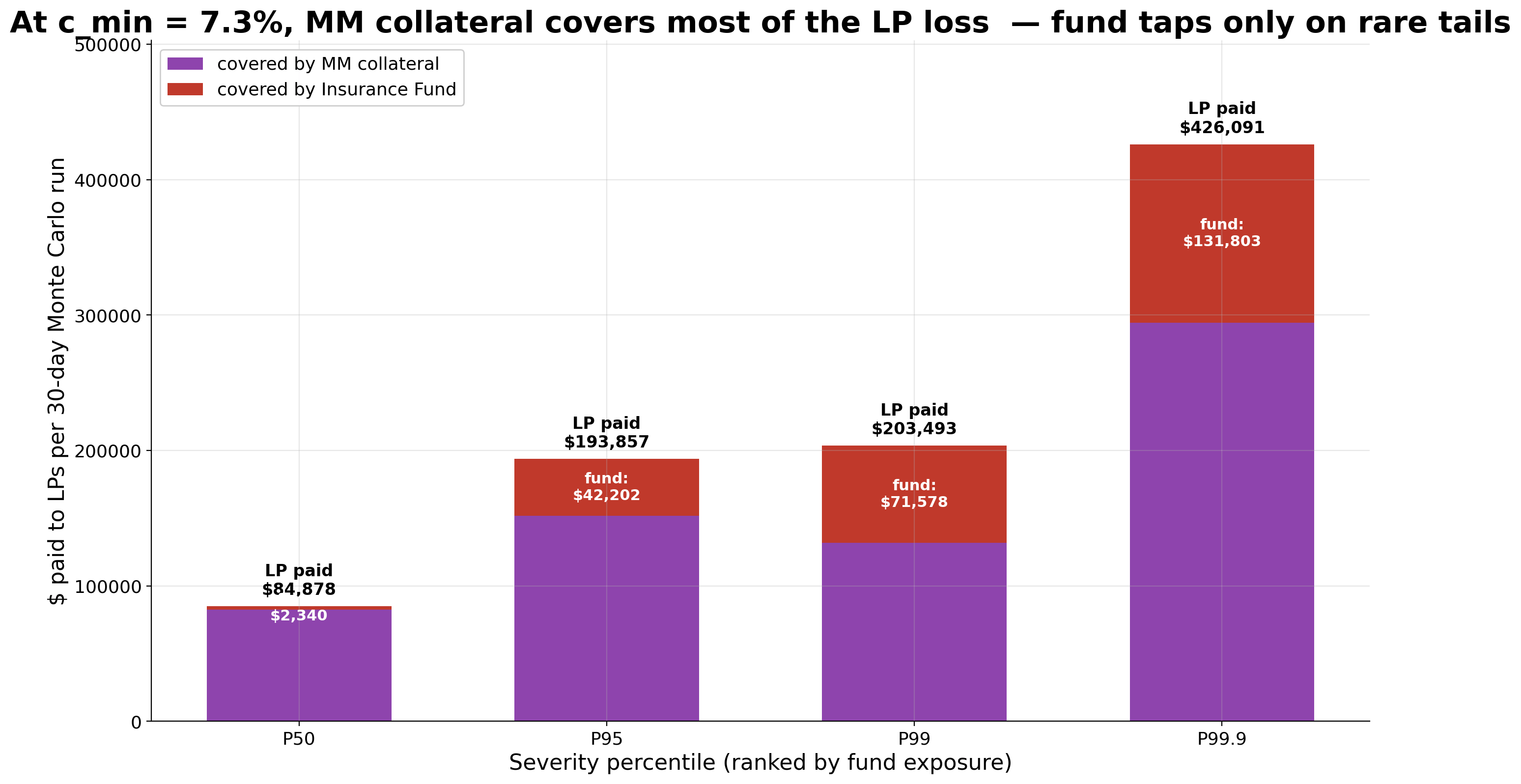 The coverage decomposition makes the same point from the LP's side: at the median and
even the P95/P99 severities, posted collateral covers essentially the entire LP loss;
the fund is touched only at the P99.9 deep tail. The LP is paid either way — the
question this page answers is **who bears the loss behind that payment**, and the
answer is the depositor.
**Limit → Why → Mitigation: these three charts are from a solvency-fund Monte Carlo, not the bare-pool depositor headline run.**
* **Limit:** the charts visualize underwriting-fund solvency under a severe correlated
crash and use a collateral-ratio framing; the **authoritative depositor numbers are
the [headline tables](#the-headline-figures-bare-pool-unhedged-untranched)** above.
* **Why:** the depositor risk panel is best stated as the exact percentile statistics
(CAGR, P(losing month), 1-in-100, worst month, P(DD>50%)); the charts add the
*shape* and the *collateralization intuition* the tables cannot show.
* **Mitigation:** read the charts as illustrations of mechanism (positive median, fat
tail, exponential ruin decay, collateral-covers-the-bulk) and the tables as the
load-bearing figures. Both agree on the substance: solvent collateral, real
downside, capital not guaranteed.
## The structural levers — how the targets are actually met
The bare pool fails the targets; the structure is the answer. Three levers, with
honest status labels:
| Lever | Effect (at `u = 0.40`, base loads) | Status |
| - | - | - |
| **Utilization cap** (`util_skew`, knee 0.45) | The **drawdown** lever: `u = 0.40 → P(DD>50%) = 2.7%` vs `u = 0.60 → 18%` | **launch** |
| **Senior / junior tranche** (`sf = 0.60`) | **Senior `P(loss) = 0`, worst `0%`**, gross CAGR \~197% — the "convexity savings account." **Junior** worst **−67%** — the high-APY first-loss vol tranche. Holds **jointly with `u ≤ 1 − sf`** | **LAUNCH** (structural invariant) |
| **Pool hedge** (`h ≈ 0.60`) | 1-in-100 → **−9.6%** (target \~−10%), worst → −12.3%, P(DD>50%) → \~0%; CAGR barely moves. **Tail-tightening, NOT solvency** | roadmap |
### Tranching is the launch lever
The dual-tranche [`ConvexityVault`](/concepts/tranches) is what turns one bare-pool
profile into two genuinely different products, **at launch** — not a roadmap promise:
At `sf = 0.60`, `u = 0.40`: **`P(loss) = 0`, worst month `0%`**, gross CAGR \~197%.
Structurally protected from underwriting loss **while the junior buffer holds and
`u ≤ 1 − sf`**. Smaller, smoother premium slice.
Worst **−67%**. Absorbs underwriting losses first and earns the **larger** premium
slice for buffering senior. High-APY, high-variance — a pure vol-selling position.
Senior protection is the structural invariant `totalLocked ≤ juniorAssets`, enforced
at every `lockCollateral`, so `Σ payouts ≤ totalLocked ≤ juniorAssets` ⇒ junior
absorbs all underwriting loss before senior is touched (see the
[tranche math](/math/no-bad-debt-math) and the [tranche product](/concepts/tranches)).
### The hedge is roadmap, and it is tail-tightening — not solvency
There is a third lever — a pool-side options hedge — and we are precise about its role:
The verified pool-hedge frontier at `u = 0.40`:
| hedge `h` | 1-in-100 month | worst month | P(DD > 50%) |
| - | - | - | - |
| 0.00 | −20.1% | −26.8% | 2.7% |
| 0.50 | −11.3% | −14.7% | 0.03% |
| **0.60** | **−9.6%** | **−12.3%** | **\~0%** |
| 0.75 | −7.0% | −8.6% | 0% |
At `h = 0.60` the 1-in-100 month meets the \~−10% target, the worst month tightens
to −12.3%, P(DD>50%) goes to \~0% — and **CAGR barely moves**, at \~1.15× fair hedge
cost (\$0.0227/mo).
The hedge **tightens the tail; it does not create the no-bad-debt guarantee** —
that is already structural in FULL. The hedge carries **basis risk**: it
approximates a fixed v3 gamma profile with a perpetual-vs-fixed options position,
so it is an *approximation*, not a guarantee. We label it honestly as
tail-tightening and keep it off the critical path.
**Limit → Why → Mitigation: the hedge is a roadmap enhancement, not a launch dependency.**
* **Limit:** the cleanest 1-in-100 ≈ −10% result depends on a pool hedge that is
**roadmap**, not shipped.
* **Why:** the hedge introduces basis risk (perpetual-vs-fixed gamma) and operational
surface; we do not want depositor solvency to depend on an approximation.
* **Mitigation:** the **launch** levers — the utilization cap and the senior/junior
tranche — already make the product honest and viable for two audiences without it.
The hedge is additive tail-tightening, and no part of the no-bad-debt guarantee
rests on it.
## The mandatory disclosure tone
The quant did not just produce numbers — it fixed the **exact language** every
depositor surface must use. This is verbatim, not paraphrasable:
> "You earn the volatility risk premium in calm markets and absorb losses in crashes.
> In FULL the pool cannot become insolvent and cannot be run, but **YOUR CAPITAL IS
> NOT GUARANTEED.**"
The rules around it are equally firm:
The product is a volatility seller. Calling it stable would be a
misrepresentation, not a softening.
Never the arithmetic mean. APY figures are gross of demand, competition, and fees,
and are model-illustrative — the **risk panel** is the robust part.
**The model is, if anything, net-conservative to depositors.** The
[`σ_ref`](/math/sigma-ref) floor of **0.50** sits *above* observed calm ETH vol
(\~0.45), so the pool **overcharges** the \~27% of months that are calm. The heavy
run's all-months realized **payout/premium = 0.654** — i.e. over the full
distribution the pool collected materially more than it paid. The conservatism is
structural, not assumed.
**Structures ship from day one; the full DYNAMICS (pool-vs-MM spread as a forward-vol signal) mature with multiple competing MMs and volume. The dataset begins at the single redeploy; the off-chain telemetry halves begin at the first interaction logged.**
What Inflexion offers today is the **architecture and the first public view** into the microstructure of the DeFi LP volatility-risk premium — not yet a mature dataset:
* **Structures are present day-one.** All five non-circular behavioral signals are defined and queryable from launch.
* **Dynamics mature with volume.** The richer signal — the pool-vs-MM spread read as a forward-vol indicator — only sharpens once multiple market makers compete and real flow accumulates.
* **The dataset begins at the single redeploy**, and the off-chain telemetry halves begin at the first interaction logged. History is served live from the subgraph via the API; if a backing (subgraph URL / RPC / telemetry) is absent, surfaces degrade to a typed `pending` state — never an error.
## What the adversarial audit confirmed
A **6-agent adversarial self-audit** independently re-ran the engine and confirmed
each load-bearing claim:
`max_payout_frac = 1.000000` across every path and the widened log-move grid.
`min(IL, MaxIL)/MaxIL ≤ 1.0` always, independent of any oracle — the LP guarantee
(Claim A) does not depend on the depositor outcome.
The bare single-pair pool fails the safety targets even under *heavier* stress.
The targets were **not loosened**; the structural levers are the answer.
Premium is collected risk-neutral at `σ_ref`; payout is paid under the real
measure. The edge is the (real) gap between them, not an accounting artifact.
`σ_ref` floor 0.50 > calm vol 0.45 overcharges the 27% of calm months;
all-months payout/premium = 0.654. The pool errs toward depositor safety.
The result rests on the part that is *structural* (no bad debt, the senior invariant,
the I10 cap, the conservative `σ_ref`) and is honest about the part that is *economic*
(selling volatility is intrinsically high-variance, and no engineering makes a vol
seller low-risk). The dual-tranche structure does not hide that risk — it lets each
depositor pick a dose: senior for the convexity savings account, junior for the
high-APY vol tranche.
What this disclosure does **not** claim matters as much as what it does. A single-pair
unhedged pool is **not** safe — the numbers above show why. The LP and depositor
claims are **never** merged. No target was loosened. The downside is printed in full.
## The two claims, stated side by side
This is the page where both load-bearing disclosures belong together. They are
**separate** and must never be combined.
The LP-facing guarantee is structural and oracle-independent — it holds regardless of
how the depositor P\&L moves:
**LPs are always paid with no bad debt in FULL mode — qualified: capped payoff + solvent USDC + oracle/settlement liveness.**
The no-bad-debt guarantee is **exact only** under the full clause:
* **FULL collateralization** — the underwriter has posted exactly `MaxIL` per swap, locked for the life of the position.
* **Capped payoff** — the payout is `min(realized_IL, MaxIL)`. The cap is load-bearing: it is what makes `payout ≤ collateral` hold by construction.
* **Solvent USDC** — the collateral numeraire (`dUSDC`) holds its peg and remains redeemable.
* **Oracle / settlement liveness** — the price oracle stays live and `settle()` runs within the protocol's settlement window.
* **No rehypothecation breach** — locked collateral stays instantly liquid; it is never routed to utilization-gated venues.
Stated without these qualifiers, the guarantee is **not** correct.
The depositor-facing reality is the opposite: capital is at risk for **both**
tranches, junior first.
**Depositor capital is NOT guaranteed: the junior tranche is first-loss; the senior tranche is structurally protected from underwriting loss only, not systemic tail.**
Underwriting capital — whether supplied to the pooled cvAMM vault (Path A) or posted directly by a market maker (Path B) — is **at risk**:
* **Junior tranche — first-loss.** Junior depositors absorb underwriting losses first and buffer the senior tranche.
* **Senior tranche — protected from underwriting loss, exposed to the systemic tail.** The senior tranche is structurally shielded from ordinary underwriting loss while junior capital buffers, but it still takes the systemic tail once the junior buffer is exhausted.
No-bad-debt is a guarantee to the **LP being paid** (see the FULL-mode payout clause), **not** a guarantee that depositor or MM capital is preserved.
The split, one more time: the LP's [no-bad-debt guarantee](/concepts/no-bad-debt)
(Claim A) is *structural* — `collateral = MaxIL ≥ payout` by construction — and is
**orthogonal to every pricing oracle and to the tranche split**. The depositor's
capital-at-risk ([Claim B](/concepts/tranches)) is the economic substance of being a
volatility seller. Senior protection sits *inside* Claim B; it reduces, but never
eliminates, junior-then-systemic risk, and it never reaches across to the LP side.
**Network:** Arbitrum Sepolia · **chainId** `421614` · **deploy block** `274081134` (subgraph startBlock) · **deployed** 2026-06-05
## Core protocol
| Contract | Address | Role |
| - | - | - |
| InflexionCore | `0xC19865cF8403F59B8Eca835833aFEe3Aa8DA4848` | Main entry point — quotes, createSwap, settlement |
| ILVault | `0x9f7615Aca943832977CEf3ac1862fD48B87b7664` | Holds LP premiums and protocol IL accounting |
| UnderwriterVault | `0x4Fb459F3393D206c2b7faD7f0fC9C35a78348D64` | Market-maker (Path B) collateral deposits |
| ConvexityVault | `0xDE2fFeBA2E6A18f3A53D43EC0fCCD299158eC30d` | Pooled cvAMM (Path A) underwriter collateral |
| Treasury | `0x96455C9b00D530BD0629b71B674298440328b1Dd` | Protocol fee recipient (also deployer) |
## Stylus & libraries
| Contract | Address | Role |
| - | - | - |
| FairValueOracle (Stylus) | `0x98a6aa75108b70fc0794bc3b87efe0ae99d5d52c` | Rust/WASM fair-premium pricing (set-once init to live VolOracle) |
| ILMath | `0x7e90362bc6Df9cb5faA13952e07853ab16c77bd2` | Core impermanent-loss math |
| TickMath (library) | `0xbf02bbc82e0fb1a4b9828bb90fc9dd9e97578965` | Tick ↔ sqrtPrice conversions (delegatecall) |
| CvammPricing (library) | `0x4a053d29a55a64172140f9ebbc27c321c0ba2b53` | Path-A pool pricing components (delegatecall) |
| SwapMath (library) | `0xf7be9745b6768d06a18c386c6db5c8cb065ba314` | Swap math helpers (delegatecall) |
| QuoteVerification (library) | `0x74819eed322f3e1a2dc10bb0d3cae50078d90807` | EIP-712 quote signature verification (delegatecall) |
## Oracles
| Contract | Address | Role |
| - | - | - |
| OracleManager | `0x2c18147B6ec75dcb330d9A48B6B96a4d1a8b529b` | Chainlink feed router, staleness & sequencer checks |
| VolOracle | `0xfdEafBB381192FC5337499d041eaead04d565Ed9` | Realized-volatility reference (sigma\_ref) |
## Uniswap
| Contract | Address | Role |
| - | - | - |
| UniswapV3Factory | `0x248AB79Bbb9bC29bB72f7Cd42F17e054Fc40188e` | v3 pool factory |
| NonfungiblePositionManager | `0x6b2937Bde17889EDCf8fbD8dE31C3C2a70Bc4d65` | LP position NFTs |
| SwapRouter02 | `0x101F443B4d1b059569D643917553c771E1b9663E` | Swap routing |
| QuoterV2 | `0x2779a0CC1c3e0E44D2542EC3e79e3864Ae93Ef0B` | Off-chain swap quoting |
## Chainlink feeds
| Contract | Address | Role |
| - | - | - |
| ETH / USD | `0xd30e2101a97dcbAeBCBC04F14C3f624E67A35165` | Price feed (8 dec, \~120s heartbeat) |
| BTC / USD | `0x56a43EB56Da12C0dc1D972ACb089c06a5dEF8e69` | Price feed (8 dec, \~120s heartbeat) |
| ARB / USD | `0xD1092a65338d049DB68D7Be6bD89d17a0929945e` | Price feed (8 dec, 86400s heartbeat) |
| USDC / USD | `0x0153002d20B96532C639313c2d54c3dA09109309` | Price feed (8 dec, 86400s heartbeat) |
## Demo tokens / pool / LP
| Contract | Address | Role |
| - | - | - |
| WETH9 | `0x980B62Da83eFf3D4576C647993b0c1D7faf17c73` | Canonical Arbitrum Sepolia WETH (18 dec) |
| USDC (Circle) | `0x75faf114eafb1BDbe2F0316DF893fd58CE46AA4d` | Circle native testnet USDC (6 dec) |
| dWETH (demo) | `0xA8C07E1B245B346c5D1910c5055Efe67bF9E7D1D` | Mock WETH, oracle-priced via Chainlink ETH/USD (18 dec) |
| dUSDC (demo) | `0xB89630Dc6e020ae2A84aE72b7d9EEDBDfb2C544d` | Mock USDC numeraire (6 dec) |
| Demo pool (dWETH/dUSDC, fee 500) | `0xfE1Eb4D5796a350B13852F822B3E6a9fDbb858a5` | Seeded v3 pool, tokenId 3218 \~\$100k unprotected LP |
## Lifecycle swaps
| Contract | Address | Role |
| - | - | - |
| Market maker (demo signer) | `0xe632B215120dD43A719458487bA3e03638fec953` | Path-B underwriter; deposited 5,000 dUSDC, own collateral paid settlement |
Live create→settle lifecycle (2026-06-05, short 300s fee-500 market `0xb8bbd684f213d5833886ade7b531a6949d85522249881a2b5d46a5cc76e439c2`):
* **Path A (cvAMM convexity)** — swapId 1, LP tokenId 3220 · V0 \$270,531.28 · MaxIL \$1,669.24 · premium \$9.70 (0.58% of MaxIL) · settled payout \$148.64 from ConvexityVault.
* **Path B (MM routing)** — swapId 2, LP tokenId 3221 · MM beat cvAMM (\$8.93 vs \$13.80) · MaxIL \$3,215.65 · MM collateral locked \$3,215.65 · settled payout \$245.66 from MM collateral.
## Where to go next
The premium waterfall in, the loss waterfall out, and the senior-protection
invariant that makes `seniorLoss` provably 0.
Deposit into senior or junior, read the live risk panel, request a withdrawal.
`baseLoad`, `util_skew`, `dispersion_skew`, and the I10 clamp — where the
utilization drawdown lever lives.
Why the LP guarantee is structural and orthogonal to everything on this page.
This documentation is built and hosted on [Mintlify](https://mintlify.com), a developer documentation platform.
The coverage decomposition makes the same point from the LP's side: at the median and
even the P95/P99 severities, posted collateral covers essentially the entire LP loss;
the fund is touched only at the P99.9 deep tail. The LP is paid either way — the
question this page answers is **who bears the loss behind that payment**, and the
answer is the depositor.
**Limit → Why → Mitigation: these three charts are from a solvency-fund Monte Carlo, not the bare-pool depositor headline run.**
* **Limit:** the charts visualize underwriting-fund solvency under a severe correlated
crash and use a collateral-ratio framing; the **authoritative depositor numbers are
the [headline tables](#the-headline-figures-bare-pool-unhedged-untranched)** above.
* **Why:** the depositor risk panel is best stated as the exact percentile statistics
(CAGR, P(losing month), 1-in-100, worst month, P(DD>50%)); the charts add the
*shape* and the *collateralization intuition* the tables cannot show.
* **Mitigation:** read the charts as illustrations of mechanism (positive median, fat
tail, exponential ruin decay, collateral-covers-the-bulk) and the tables as the
load-bearing figures. Both agree on the substance: solvent collateral, real
downside, capital not guaranteed.
## The structural levers — how the targets are actually met
The bare pool fails the targets; the structure is the answer. Three levers, with
honest status labels:
| Lever | Effect (at `u = 0.40`, base loads) | Status |
| - | - | - |
| **Utilization cap** (`util_skew`, knee 0.45) | The **drawdown** lever: `u = 0.40 → P(DD>50%) = 2.7%` vs `u = 0.60 → 18%` | **launch** |
| **Senior / junior tranche** (`sf = 0.60`) | **Senior `P(loss) = 0`, worst `0%`**, gross CAGR \~197% — the "convexity savings account." **Junior** worst **−67%** — the high-APY first-loss vol tranche. Holds **jointly with `u ≤ 1 − sf`** | **LAUNCH** (structural invariant) |
| **Pool hedge** (`h ≈ 0.60`) | 1-in-100 → **−9.6%** (target \~−10%), worst → −12.3%, P(DD>50%) → \~0%; CAGR barely moves. **Tail-tightening, NOT solvency** | roadmap |
### Tranching is the launch lever
The dual-tranche [`ConvexityVault`](/concepts/tranches) is what turns one bare-pool
profile into two genuinely different products, **at launch** — not a roadmap promise:
At `sf = 0.60`, `u = 0.40`: **`P(loss) = 0`, worst month `0%`**, gross CAGR \~197%.
Structurally protected from underwriting loss **while the junior buffer holds and
`u ≤ 1 − sf`**. Smaller, smoother premium slice.
Worst **−67%**. Absorbs underwriting losses first and earns the **larger** premium
slice for buffering senior. High-APY, high-variance — a pure vol-selling position.
Senior protection is the structural invariant `totalLocked ≤ juniorAssets`, enforced
at every `lockCollateral`, so `Σ payouts ≤ totalLocked ≤ juniorAssets` ⇒ junior
absorbs all underwriting loss before senior is touched (see the
[tranche math](/math/no-bad-debt-math) and the [tranche product](/concepts/tranches)).
### The hedge is roadmap, and it is tail-tightening — not solvency
There is a third lever — a pool-side options hedge — and we are precise about its role:
The verified pool-hedge frontier at `u = 0.40`:
| hedge `h` | 1-in-100 month | worst month | P(DD > 50%) |
| - | - | - | - |
| 0.00 | −20.1% | −26.8% | 2.7% |
| 0.50 | −11.3% | −14.7% | 0.03% |
| **0.60** | **−9.6%** | **−12.3%** | **\~0%** |
| 0.75 | −7.0% | −8.6% | 0% |
At `h = 0.60` the 1-in-100 month meets the \~−10% target, the worst month tightens
to −12.3%, P(DD>50%) goes to \~0% — and **CAGR barely moves**, at \~1.15× fair hedge
cost (\$0.0227/mo).
The hedge **tightens the tail; it does not create the no-bad-debt guarantee** —
that is already structural in FULL. The hedge carries **basis risk**: it
approximates a fixed v3 gamma profile with a perpetual-vs-fixed options position,
so it is an *approximation*, not a guarantee. We label it honestly as
tail-tightening and keep it off the critical path.
**Limit → Why → Mitigation: the hedge is a roadmap enhancement, not a launch dependency.**
* **Limit:** the cleanest 1-in-100 ≈ −10% result depends on a pool hedge that is
**roadmap**, not shipped.
* **Why:** the hedge introduces basis risk (perpetual-vs-fixed gamma) and operational
surface; we do not want depositor solvency to depend on an approximation.
* **Mitigation:** the **launch** levers — the utilization cap and the senior/junior
tranche — already make the product honest and viable for two audiences without it.
The hedge is additive tail-tightening, and no part of the no-bad-debt guarantee
rests on it.
## The mandatory disclosure tone
The quant did not just produce numbers — it fixed the **exact language** every
depositor surface must use. This is verbatim, not paraphrasable:
> "You earn the volatility risk premium in calm markets and absorb losses in crashes.
> In FULL the pool cannot become insolvent and cannot be run, but **YOUR CAPITAL IS
> NOT GUARANTEED.**"
The rules around it are equally firm:
The product is a volatility seller. Calling it stable would be a
misrepresentation, not a softening.
Never the arithmetic mean. APY figures are gross of demand, competition, and fees,
and are model-illustrative — the **risk panel** is the robust part.
**The model is, if anything, net-conservative to depositors.** The
[`σ_ref`](/math/sigma-ref) floor of **0.50** sits *above* observed calm ETH vol
(\~0.45), so the pool **overcharges** the \~27% of months that are calm. The heavy
run's all-months realized **payout/premium = 0.654** — i.e. over the full
distribution the pool collected materially more than it paid. The conservatism is
structural, not assumed.
**Structures ship from day one; the full DYNAMICS (pool-vs-MM spread as a forward-vol signal) mature with multiple competing MMs and volume. The dataset begins at the single redeploy; the off-chain telemetry halves begin at the first interaction logged.**
What Inflexion offers today is the **architecture and the first public view** into the microstructure of the DeFi LP volatility-risk premium — not yet a mature dataset:
* **Structures are present day-one.** All five non-circular behavioral signals are defined and queryable from launch.
* **Dynamics mature with volume.** The richer signal — the pool-vs-MM spread read as a forward-vol indicator — only sharpens once multiple market makers compete and real flow accumulates.
* **The dataset begins at the single redeploy**, and the off-chain telemetry halves begin at the first interaction logged. History is served live from the subgraph via the API; if a backing (subgraph URL / RPC / telemetry) is absent, surfaces degrade to a typed `pending` state — never an error.
## What the adversarial audit confirmed
A **6-agent adversarial self-audit** independently re-ran the engine and confirmed
each load-bearing claim:
`max_payout_frac = 1.000000` across every path and the widened log-move grid.
`min(IL, MaxIL)/MaxIL ≤ 1.0` always, independent of any oracle — the LP guarantee
(Claim A) does not depend on the depositor outcome.
The bare single-pair pool fails the safety targets even under *heavier* stress.
The targets were **not loosened**; the structural levers are the answer.
Premium is collected risk-neutral at `σ_ref`; payout is paid under the real
measure. The edge is the (real) gap between them, not an accounting artifact.
`σ_ref` floor 0.50 > calm vol 0.45 overcharges the 27% of calm months;
all-months payout/premium = 0.654. The pool errs toward depositor safety.
The result rests on the part that is *structural* (no bad debt, the senior invariant,
the I10 cap, the conservative `σ_ref`) and is honest about the part that is *economic*
(selling volatility is intrinsically high-variance, and no engineering makes a vol
seller low-risk). The dual-tranche structure does not hide that risk — it lets each
depositor pick a dose: senior for the convexity savings account, junior for the
high-APY vol tranche.
What this disclosure does **not** claim matters as much as what it does. A single-pair
unhedged pool is **not** safe — the numbers above show why. The LP and depositor
claims are **never** merged. No target was loosened. The downside is printed in full.
## The two claims, stated side by side
This is the page where both load-bearing disclosures belong together. They are
**separate** and must never be combined.
The LP-facing guarantee is structural and oracle-independent — it holds regardless of
how the depositor P\&L moves:
**LPs are always paid with no bad debt in FULL mode — qualified: capped payoff + solvent USDC + oracle/settlement liveness.**
The no-bad-debt guarantee is **exact only** under the full clause:
* **FULL collateralization** — the underwriter has posted exactly `MaxIL` per swap, locked for the life of the position.
* **Capped payoff** — the payout is `min(realized_IL, MaxIL)`. The cap is load-bearing: it is what makes `payout ≤ collateral` hold by construction.
* **Solvent USDC** — the collateral numeraire (`dUSDC`) holds its peg and remains redeemable.
* **Oracle / settlement liveness** — the price oracle stays live and `settle()` runs within the protocol's settlement window.
* **No rehypothecation breach** — locked collateral stays instantly liquid; it is never routed to utilization-gated venues.
Stated without these qualifiers, the guarantee is **not** correct.
The depositor-facing reality is the opposite: capital is at risk for **both**
tranches, junior first.
**Depositor capital is NOT guaranteed: the junior tranche is first-loss; the senior tranche is structurally protected from underwriting loss only, not systemic tail.**
Underwriting capital — whether supplied to the pooled cvAMM vault (Path A) or posted directly by a market maker (Path B) — is **at risk**:
* **Junior tranche — first-loss.** Junior depositors absorb underwriting losses first and buffer the senior tranche.
* **Senior tranche — protected from underwriting loss, exposed to the systemic tail.** The senior tranche is structurally shielded from ordinary underwriting loss while junior capital buffers, but it still takes the systemic tail once the junior buffer is exhausted.
No-bad-debt is a guarantee to the **LP being paid** (see the FULL-mode payout clause), **not** a guarantee that depositor or MM capital is preserved.
The split, one more time: the LP's [no-bad-debt guarantee](/concepts/no-bad-debt)
(Claim A) is *structural* — `collateral = MaxIL ≥ payout` by construction — and is
**orthogonal to every pricing oracle and to the tranche split**. The depositor's
capital-at-risk ([Claim B](/concepts/tranches)) is the economic substance of being a
volatility seller. Senior protection sits *inside* Claim B; it reduces, but never
eliminates, junior-then-systemic risk, and it never reaches across to the LP side.
**Network:** Arbitrum Sepolia · **chainId** `421614` · **deploy block** `274081134` (subgraph startBlock) · **deployed** 2026-06-05
## Core protocol
| Contract | Address | Role |
| - | - | - |
| InflexionCore | `0xC19865cF8403F59B8Eca835833aFEe3Aa8DA4848` | Main entry point — quotes, createSwap, settlement |
| ILVault | `0x9f7615Aca943832977CEf3ac1862fD48B87b7664` | Holds LP premiums and protocol IL accounting |
| UnderwriterVault | `0x4Fb459F3393D206c2b7faD7f0fC9C35a78348D64` | Market-maker (Path B) collateral deposits |
| ConvexityVault | `0xDE2fFeBA2E6A18f3A53D43EC0fCCD299158eC30d` | Pooled cvAMM (Path A) underwriter collateral |
| Treasury | `0x96455C9b00D530BD0629b71B674298440328b1Dd` | Protocol fee recipient (also deployer) |
## Stylus & libraries
| Contract | Address | Role |
| - | - | - |
| FairValueOracle (Stylus) | `0x98a6aa75108b70fc0794bc3b87efe0ae99d5d52c` | Rust/WASM fair-premium pricing (set-once init to live VolOracle) |
| ILMath | `0x7e90362bc6Df9cb5faA13952e07853ab16c77bd2` | Core impermanent-loss math |
| TickMath (library) | `0xbf02bbc82e0fb1a4b9828bb90fc9dd9e97578965` | Tick ↔ sqrtPrice conversions (delegatecall) |
| CvammPricing (library) | `0x4a053d29a55a64172140f9ebbc27c321c0ba2b53` | Path-A pool pricing components (delegatecall) |
| SwapMath (library) | `0xf7be9745b6768d06a18c386c6db5c8cb065ba314` | Swap math helpers (delegatecall) |
| QuoteVerification (library) | `0x74819eed322f3e1a2dc10bb0d3cae50078d90807` | EIP-712 quote signature verification (delegatecall) |
## Oracles
| Contract | Address | Role |
| - | - | - |
| OracleManager | `0x2c18147B6ec75dcb330d9A48B6B96a4d1a8b529b` | Chainlink feed router, staleness & sequencer checks |
| VolOracle | `0xfdEafBB381192FC5337499d041eaead04d565Ed9` | Realized-volatility reference (sigma\_ref) |
## Uniswap
| Contract | Address | Role |
| - | - | - |
| UniswapV3Factory | `0x248AB79Bbb9bC29bB72f7Cd42F17e054Fc40188e` | v3 pool factory |
| NonfungiblePositionManager | `0x6b2937Bde17889EDCf8fbD8dE31C3C2a70Bc4d65` | LP position NFTs |
| SwapRouter02 | `0x101F443B4d1b059569D643917553c771E1b9663E` | Swap routing |
| QuoterV2 | `0x2779a0CC1c3e0E44D2542EC3e79e3864Ae93Ef0B` | Off-chain swap quoting |
## Chainlink feeds
| Contract | Address | Role |
| - | - | - |
| ETH / USD | `0xd30e2101a97dcbAeBCBC04F14C3f624E67A35165` | Price feed (8 dec, \~120s heartbeat) |
| BTC / USD | `0x56a43EB56Da12C0dc1D972ACb089c06a5dEF8e69` | Price feed (8 dec, \~120s heartbeat) |
| ARB / USD | `0xD1092a65338d049DB68D7Be6bD89d17a0929945e` | Price feed (8 dec, 86400s heartbeat) |
| USDC / USD | `0x0153002d20B96532C639313c2d54c3dA09109309` | Price feed (8 dec, 86400s heartbeat) |
## Demo tokens / pool / LP
| Contract | Address | Role |
| - | - | - |
| WETH9 | `0x980B62Da83eFf3D4576C647993b0c1D7faf17c73` | Canonical Arbitrum Sepolia WETH (18 dec) |
| USDC (Circle) | `0x75faf114eafb1BDbe2F0316DF893fd58CE46AA4d` | Circle native testnet USDC (6 dec) |
| dWETH (demo) | `0xA8C07E1B245B346c5D1910c5055Efe67bF9E7D1D` | Mock WETH, oracle-priced via Chainlink ETH/USD (18 dec) |
| dUSDC (demo) | `0xB89630Dc6e020ae2A84aE72b7d9EEDBDfb2C544d` | Mock USDC numeraire (6 dec) |
| Demo pool (dWETH/dUSDC, fee 500) | `0xfE1Eb4D5796a350B13852F822B3E6a9fDbb858a5` | Seeded v3 pool, tokenId 3218 \~\$100k unprotected LP |
## Lifecycle swaps
| Contract | Address | Role |
| - | - | - |
| Market maker (demo signer) | `0xe632B215120dD43A719458487bA3e03638fec953` | Path-B underwriter; deposited 5,000 dUSDC, own collateral paid settlement |
Live create→settle lifecycle (2026-06-05, short 300s fee-500 market `0xb8bbd684f213d5833886ade7b531a6949d85522249881a2b5d46a5cc76e439c2`):
* **Path A (cvAMM convexity)** — swapId 1, LP tokenId 3220 · V0 \$270,531.28 · MaxIL \$1,669.24 · premium \$9.70 (0.58% of MaxIL) · settled payout \$148.64 from ConvexityVault.
* **Path B (MM routing)** — swapId 2, LP tokenId 3221 · MM beat cvAMM (\$8.93 vs \$13.80) · MaxIL \$3,215.65 · MM collateral locked \$3,215.65 · settled payout \$245.66 from MM collateral.
## Where to go next
The premium waterfall in, the loss waterfall out, and the senior-protection
invariant that makes `seniorLoss` provably 0.
Deposit into senior or junior, read the live risk panel, request a withdrawal.
`baseLoad`, `util_skew`, `dispersion_skew`, and the I10 clamp — where the
utilization drawdown lever lives.
Why the LP guarantee is structural and orthogonal to everything on this page.
This documentation is built and hosted on [Mintlify](https://mintlify.com), a developer documentation platform.